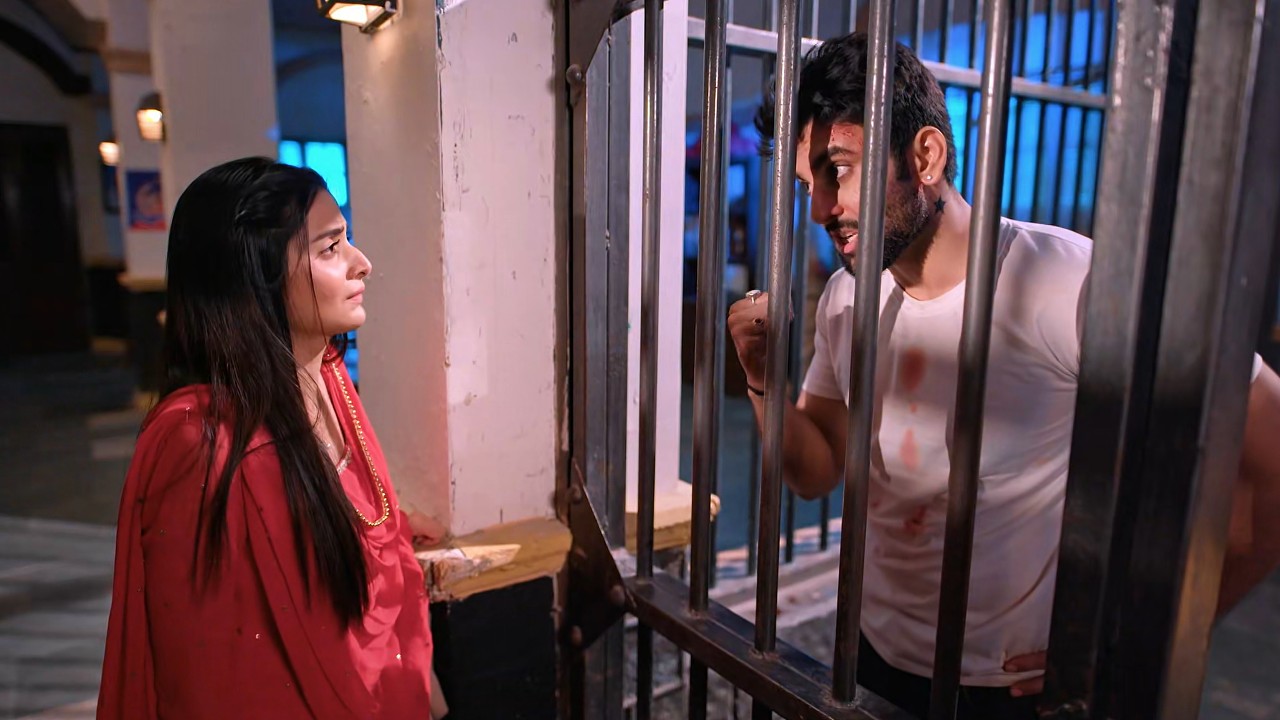



In Yeh Fitoor Tera Week 4, Saumya finally breaks years of fear to expose Roop, while Jeet’s selfless act behind bars redefines true empowerment.
Photo Credit: JioHotstar

Credits

Cast: Ishhan Dhawan, Debchandrima Singha Roy, Mohit Duseja, Aman Verma, Sanjeev Seth, Rinku Ghosh, Eindraneel Bhattacharya, Arnav Maggo, Farida Dadi, Gunn Kansara, Ishani Banerjee, Neha Narang, Rahul Ailani

Director: Arshad Khan

Concept: Ved Raj

Episodic Story-telling: Pavni Mehandiratta, Malavika Asthana

Screenplay: Bhavna Vyas

Dialogues: Shivangi Singh

Editor: Shashank Singh

Costumes: Ritu Deora, Karishma Salian

Cinematography: Sarfaraz Meghani

Creative Team: Janhvi Aasthana, Sankalp Gala

Streaming Platforms: Star Plus, JioHotstar

Plot Recap (Episodes 19-25)

The week begins with a classic ‘oops’ moment when Saumya walks in on Jeet taking a bath in a booth in the garage. She shields her eyes like a dutiful heroine, but not before sneaking a guilty little peek. Once the steam clears (literally), Jeet asks why she’s braved his makeshift quarters. When she promises to speak to her father for him, Jeet urges her to also stand up for herself. Embarrassed but touched, she hands him his grandmother’s ashes and asks him to return home.

At the Saxena house, the drama is boiling. Sanjeev tries to shove Ridhan into an arranged marriage, but Nita fires back, dragging his old affairs into the spotlight. Meanwhile, at Saumya’s home, Anoop praises Roop, sparking Krish and Soumya to defend Jeet. When Anoop raises his hand against Krish, Saumya shields her brother. Just then, Uma (Taiji) drops a bombshell by accusing Saumya of having a secret affair with Jeet.

But Anoop, for once, steps in to defend his daughter. While the family gears up for the Jagrata, Ridhan quietly plans to propose to Soumya under the holy lights. On the other hand, a flat tire threatens to wreck the event. But Jeet arrives like a savior, carrying Mata Rani’s idol right on time for the Sthapna. Anoop tries to push him out, but Dadi takes charge. She blesses Jeet with a tilak and asks him to serve bhog alongside Ridhan.

After a playful moment with Saumya while serving food at the bhog, Jeet quickly shifts gears to protect local children from Roop’s predatory tricks. Sanjeev, blind to the danger, crowns Roop as Sangeet Samrat, giving him the swagger to mock Jeet and drag a trembling Saumya on stage to present him with a ceremonial shawl. Later, Roop tries to lure little Pihu into an empty house, but Saumya steps in to shield the child. Cornered and threatened, she faces Roop’s menace until Jeet arrives just in time to stop him.

Jeet unleashes his fury on Roop for targeting little Pihu, but the moment backfires when Pihu denies being touched. The crowd quickly turns against Jeet, and Sanjeev adds insult by slapping him before Anoop has him dragged off by the police. Inside the house, Uma drops a shocking truth. She admits that she always knew about Roop’s abusive past and begs Saumya and Madhu to stay quiet for the sake of family honor. Saumya, torn with guilt for failing the man who protected her, remembers Jeet’s faith in her strength. With new resolve, she finally decides to break her silence and races to the police station to stand by him.

Anoop pays Jeet a visit in the lock-up, and Jeet, in his own sharp way, turns the meeting into an interesting confrontation. He hints that Anup should look deeper when it comes to Saumya. Meanwhile, Saumya runs from one police station to another until she finally finds Jeet, battered and broken behind bars. Her tears move the officers, and she pleads until they agree to drop the charges. Just when freedom is within reach, Jeet shocks her by locking himself back inside and handing her the key. He refuses to walk out unless she breaks her silence, exposes Roop, and frees herself from the prison of fear.

Hidden in the shadows, Ridhan overhears every word and learns the painful truth about Roop’s abuse and Soumya’s trauma. The moment leaves Soumya standing at a crossroads, her voice the only weapon that can change everything.

Jeet sends Saumya home, reminding her that she must fight her own battle and asking Ridhan to stand by her as support. Back at home, Madhu pushes back against Anoop’s angry outburst, while Uma, weighed down by guilt, admits to Madhu that she always knew about Roop’s abusive past. Roop overhears their talk. Later, he slaps Uma, and threatens to destroy her if she dares to speak out. Saumya, carrying Jeet’s words in her heart and strengthened by Ridhan’s support, returns home with new courage. When Roop tries to frame her, she finally breaks her silence in front of the entire family.

Saumya finally lays bare Roop’s dark past, exposing both his childhood abuse and his recent attempt to prey on Pihu. The truth hits Anup like a storm. When Roop tries to raise his hand against Saumya, Anoop stops him mid-swing and disowns him completely. The revelations keep coming as Anoop learns how Madhu secretly shielded Saumya for years, leaving him crushed with guilt. He walks out, heavy with regret, and withdraws the police complaint against Jeet.

Jeet, now free, urges Anoop to return home and share his daughter’s pain instead of hiding from it. With that, Jeet steps back into the family house. But the moment of relief is shattered when Roop, unrepentant and smirking, declares that the house is legally his and no one can force him out.

ALSO READ: Yeh Fitoor Tera Week 3 Review: Ishhan Dhawan And Debchandrima Singha Roy Slide Past Patriarchal Traps In A Storm Of Truth

Character Development

Saumya’s journey in this week is nothing short of a rebirth. At the start of Episode 19, she is weighed down by silence, carrying her trauma like a hidden burden while bending under the pressure of family honor. Uma’s taunts sting, her father’s disappointment looms, and society’s rules keep her trapped in a cage of compliance.

The shift begins slowly, sparked by Jeet’s faith in her. His most powerful act comes in Episode 23 when he locks himself inside the police cell, refusing freedom until Saumya claims her own. That moment flips the mirror back on her. She realizes her silence is not protecting anyone. It is giving Roop more power and putting little Pihu in danger.

By Episode 24, Saumya finally steps into the light. She walks into her home, faces Roop, and speaks the truth aloud. Her voice cuts through years of fear as she accuses him of sexual assault in front of her stunned family. It is her transformation from a victim who survived by staying quiet into a woman who reclaims her agency.

Saumya’s evolution is the heart of this arc. What began as learned helplessness shaped by trauma and toxic notions of honor ends with her breaking free. Jeet’s refusal to play savior forces her to find her own strength, and Ridhan’s support steadies her path. By confronting Roop, she moves from silence to autonomy, proving that her voice is her liberation.

Jeet’s first instinct when he sees Roop near Saumya is pure aggression. He thrashes him without hesitation, but soon realizes that violence only stops the moment, not the deeper wound Saumya carries.

His real strength shows when he refuses to let Saumya depend on him as her permanent shield. Many protectors fall into the trap of the savior role, keeping the victim tied to their rescue. But Jeet chooses a different path. By locking himself back inside the jail cell and handing Soumya the key, he creates a situation where she has no choice but to step up.

This act is not about punishment or pride. It is a deliberate sacrifice that forces Saumya to confront her fear. By placing himself in danger, Jeet aligns his pain with her truth, giving her the urgency and emotional push she needs to break her silence. His journey this week shows that real empowerment is not about fighting someone else’s battles but about helping them find the courage to fight their own.

Roop hides behind two powerful shields. His blindness makes him appear vulnerable, and his title of Sangeet Samrat makes him untouchable. Together, these create a perfect cover that lets him move with impunity.

He thrives on twisting reality. Gaslighting becomes his weapon of choice, making Saumya doubt herself, accusing her of affairs, and using the fear of family honor to keep her quiet. By isolating her, he ensures she feels no one will ever believe her over a respected elder.

The mask slips when his control begins to crack. As soon as Madhu and Uma start speaking out, Roop’s calm facade collapses. His covert manipulation turns into open violence. He slaps Uma and threatens her into silence. This escalation is the classic reaction of an abuser who feels his grip loosening.

Roop’s tactics show how predators exploit perception, twist trust, and lash out when their power is challenged. His downfall begins the moment Saumya refuses to play by his rules.

Ridhan’s journey in this arc is about growing up emotionally. At first, he is caught up in his own romantic bubble, passing notes, and planning a big proposal during the Jagrata. He sees Saumya as the heroine of his love story rather than a woman carrying heavy scars. His focus is on how he feels about her, not on what she is silently enduring.

The turning point comes at the police station in Episode 23. Overhearing Saumya and Jeet’s raw exchange shatters his fantasy. Ridhan suddenly sees the truth—Saumya is not waiting for romance, she is fighting for her voice after years of trauma. His first impulse is to lash out at Roop, but Jeet stops him, reminding him that this is Soumya’s battle. That check forces Ridhan to shift his perspective.

By Episode 24, Ridhan shows a new kind of maturity. Instead of chasing his own desires, he offers quiet support. His gesture of giving Soumya a simple toffee outside her house is not about romance but about comfort. He removes pressure, sets aside his own timeline, and becomes a steady presence.

Ridhan’s breakdown in front of Dadi adds another layer. His concern shifts toward Jeet, and that serves two purposes. On one hand, his worry is real. Seeing Jeet locked up and beaten stirs a deep sense of injustice. On the other hand, focusing on Jeet gives him a safe way to release his grief without exposing Soumya’s truth before she is ready. It is both genuine care and a protective buffer. Ridhan’s evolution is about moving from self-centered love to selfless empathy.

Anoop’s arc is one of the most heartbreaking collapses of pride and perception. He begins as the father who loves his daughter but ties that love tightly to reputation. In Episode 20, he earns respect by standing firmly with Soumya against Uma’s accusations, yet his blind devotion to Roop remains his fatal flaw. To him, Roop is saintly, untouchable, almost god-like.

This misplaced faith drives Anoop into denial. He lashes out at Jeet, arrests him, and convinces himself that the danger is outside the home. Jeet’s warning at the police station plants the first seed of doubt, but Anup still clings to his worldview. His mind is anchored in the image of himself as protector and honorable patriarch.

When Saumya finally breaks her silence in Episode 24, the shock is devastating. Anoop’s reality fractures in an instant. Catching Roop’s hand mid-air is his instinctive recognition that his daughter does not lie. The saintly brother image crumbles, replaced by the horror of realizing he has lived with a predator under his roof. Learning that Madhu hid the truth deepens his guilt, showing him that the honor he thought he was protecting was built on his wife and daughter’s suffering.

From that moment, his anger turns inward. Disowning Roop is his attempt to cut out the poison, but it does not heal his guilt. The discarded doll he finds becomes a symbol of his failure, pushing him into self-reproach. He openly admits that he has failed as a father, his identity as protector shattered.

His conversation with Jeet begins the slow path toward rebuilding. Jeet urges him to stop drowning in guilt and instead share Saumya’s pain. For the first time, Anoop is forced to step outside his ego and pride. Dropping the charges against Jeet is his first act of accountability, marking the shift from a man obsessed with reputation to a father finally willing to confront the wounds inside his own home.

For years, Madhu’s way of protecting Saumya was to contain the damage—keeping her away from Roop, carrying the burden herself, and staying silent. But when she finally let Saumya speak her truth to Anup, she made her first real leap away from enabling. That moment was her surrender. Her silence during Saumya’s revelation is heavy with meaning. Madhu stands still, absorbing the fallout as her husband’s world collapses, her own secret comes to light, and her guilt rises to the surface.

But once the truth is out, Madhu slips back into her old pattern of preserving family honor. Her love for Soumya is genuine, but filtered through fear of scandal and tradition. Her arc is tragic because it captures the push and pull of a mother who wants to shield her child but cannot fully break free from the cage of societal expectations.

Uma’s (Taiji) arc is built on denial and self-preservation. As Roop’s wife, admitting his true nature would destroy her identity, her social standing, and her sense of security. To protect herself, she leans on denial and projection. Instead of directing anger at Roop, she turns it on Soumya, blaming her and painting her as the troublemaker. This way, Uma convinces herself that the family is intact, even when she knows the truth in private.

Her silence is not just fear but a choice to protect her own fragile normal. She rationalizes her complicity as powerlessness, telling herself that she cannot fight the system. The tragedy of her character becomes clear when Roop’s abuse turns on her. Even then, she remains trapped, because her self-worth is tied completely to being his wife.

Unlike Madhu, who uses her guilt to create space for Soumya’s liberation, Uma stays paralyzed. Her fear of social rejection and her dependence on Roop keep her locked in complicity. She is a painful example of how love mixed with fear can turn into protection for the very predator she should resist.

Krish embodies the younger generation’s refusal to inherit fear. At first, he is caught in the household’s tension, unsure how to act. His turning point comes when Anoop slaps him for defending Jeet. Standing firm alongside Soumya, Krish chooses truth over blind obedience.

When Saumya’s truth finally comes out, his emotions boil over. He is furious at Roop and nearly strikes him, yet stops himself at the last moment. That pause shows his restraint, but his anger still finds an outlet when he throws Roop’s belongings out of the house. He makes a clear statement that the younger generation will not tolerate the hypocrisy and silence that allowed abuse to thrive.

Krish’s transformation highlights how the youngest voices in the family are no longer passive. They are ready to confront injustice directly, even when it means standing against elders.

Highlight Of The Week

The birdcage sequence from Episode 2 becomes the emotional backbone of this week’s climax. When Jeet tells Saumya from inside the prison, “Kehne ko aaj main iss lockup mein hoon, lekin meri nazaron se dekho Saumya toh tum qaid ho”, the metaphor comes full circle. Back on the terrace, the cage hanging on Jeet’s side had cast sharp shadows across Soumya’s wall, visually trapping her in her own room. That moment showed her reality, She is caged by honor, judgment, and trauma. Jeet nudging the cage back then hinted at his role, not as a hero who breaks the lock, but as the force that rattles it until she realizes she must open it herself.

Jeet locking himself inside the cell and handing Soumya the key flips the meaning of freedom. By staying behind bars, he shows that physical release means nothing if she remains mentally trapped. He forces her to see that she alone holds the key to both their liberations.

The climax in Episode 24 sharpens this symbolism. As Soumya finally speaks out and exposes Roop, the key slips from her hand and falls. That drop signals that she no longer needs to unlock any door. Her spoken truth has already shattered the lock that bound her. The fall of the key marks the exact moment her silence ends and Roop’s immunity collapses.

The week closes with a tender image. Soumya holds the key in one hand and Ridhan’s simple toffee in the other. The key reflects the agency she reclaimed through Jeet’s sacrifice, while the toffee represents Ridhan’s gentle, grounding comfort. Together, they symbolize two very different but complementary supports—Jeet’s intense push and Ridhan’s quiet warmth. For the first time, Soumya feels the lightness of freedom. The birdcage shadow that once defined her room dissolves, leaving her not as a trapped observer but as a survivor stepping into the light. These contrasting forces will now shape how she learns to trust, set boundaries, and rebuild her autonomy.

Performances

Ishhan Dhawan‘s strength lies in his eyes. In the confrontation with Eindraneel Bhattacharya, his gaze is wide and unflinching, radiating defiance. In his softer moments with Saumya, those same eyes show the weight he carries for her. His voice mirrors this duality. He moves from explosive bursts of dialogue, hitting sharp consonants, to whispers that feel intimate.

In their shared moments across the show, their performance relies heavily on unspoken glance work—Ishhan’s intense, reassuring stare grounding Debchandrima’s overwhelmed, tear-filled gazes. This non-verbal rhythm gives their joint scenes a raw pulse of shared emotion.

Debchandrima Singha Roy sustains high emotion with remarkable control. Her crying moves between gasping sobs, muffled whimpers, and sudden bursts, keeping it raw yet varied. The trembling chin, rapid blinking, and rigid posture make her vulnerability feel painfully real.

Arnav Maggo brings a quiet strength to his scene with Jeet when the latter is in the lockup. You can see the change in him as he moves from urgent concern to hesitant realization while listening through the jail bars. His listening feels alive. The steady gaze, the slight tilt of his head, and the openness in his posture make the exchange feel genuine rather than one-sided.

Eindraneel Bhattacharya captures the image of a man crushed by his own failures. His body folds in on itself, shoulders drooping and head lowered, showing the weight of regret without needing words. His breakdown feels raw and unpolished. The crack in his voice and the way his face twists in pain make the moment sting with realism. It gives his remorse a gritty truth that lingers long after the scene ends.

Aman Verma’s turn as Roop this week is chilling in its precision. Instead of playing him like a loud, exaggerated villain, he grounds Roop in unsettling realism. The shift from smooth manipulation to unraveling panic feels sharp and believable, making it all the more disturbing to watch.

In A Nutshell

This week marked a turning point for Yeh Fitoor Tera. Soumya finally became the architect of her own freedom instead of waiting for Jeet to rescue her. The road ahead is stormy. Roop prepares for a fierce legal fight over the family home, while Soumya must face her mother’s fear of scandal, Anoop’s slow redemption, and her shifting ties with Jeet and Ridhan. Each challenge will test her strength, but the story is now about Saumya building her life on her own terms.

Share.

Madhuri Prabhu is a post-graduate degree holder in Electronic Media (Department of Journalism & Communication, Mumbai University) and the brain behind Cutting Shots. She began her journey in showbiz with an internship under a TV producer and worked on a couple of daily soaps. Post her brief stint as an executive producer and assistant casting director for a YouTube channel, Hindi Kavita, Madhuri hopped into the world of entertainment journalism.

Leave A Reply

Exit mobile version
Premium SEO Backlinks