








From classroom chaos to silent late-night chemistry, Ishhan Dhawan and Debchandrima Singha Roy deliver gripping performances in Yeh Fitoor Tera Week 2.

Credits
Cast: Ishhan Dhawan, Debchandrima Singha Roy, Mohit Duseja, Aman Verma, Sanjeev Seth, Rinku Ghosh, Eindraneel Bhattacharya, Arnav Maggo, Farida Dadi, Gunn Kansara, Ishani Bannerjee, Neha Narang, Rahul Ailani
Director: Arshad Khan
Concept: Ved Raj
Episodic Story-telling: Pavni Mehandiratta, Malavika Asthana
Screenplay: Bhavna Vyas
Dialogues: Shivangi Singh
Editor: Shashank Singh
Costumes: Ritu Deora, Karishma Salian
Cinematography: Sarfaraz Meghani
Creative Team: Janhvi Aasthana, Sankalp Gala
Streaming Platforms: Star Plus, JioHotstar
Plot Recap (Episodes 5-11)
The week kicks off with intense drama as Professor Tripathi tries to take inappropriate advantage of Saumya (Debchandrima Singha Roy) under the pretense of a poetry reading. Luckily, Jeet (Ishhan Dhawan) drops by just in time to deliver him a swift (very sharp) reality check, and remind the room that consent isn’t optional. To shield Saumya from public shame, Jeet takes the blame for assault when the Professor’s son, Shaurya, alerts Principal Sanjeev (Jeet’s father).
While Saumya gets a heavy dose of victim-blaming at home, Ridhan uncovers the truth and pulls out a hockey stick to perform some aggressive career counseling on Tripathi, demanding his immediate resignation. Meanwhile, back at college, when Sanjeev and Nita push Saumya to sign a false statement against Jeet, she drops the pen and refuses. Ridhan then exposes a video confession from Tripathi, completely clearing Jeet’s name.
Jeet senses Saumya’s bottled-up trauma and encourages her to free herself from the past over a sugar paratha pep-talk. Taking that literally, she tries to block her shady uncle Roop from giving music lessons to little Pihu, only for her mother to step in and hit the mute button to save family appearances.
Naturally, Shaurya shifts his revenge tour toward Ridhan, but a panicked Saumya resorts to top-tier blackmail. She threatens to wreck Jeet’s beloved bike if he doesn’t play bodyguard. Jeet sighs, steps in, and instantly scares off the bullies.
Later, Sanjeev and Nita plot to provoke Jeet during the college football match to get him expelled. Saumya makes Jeet promise not to fight back. Despite facing brutal fouls from Shaurya in the first half, Jeet holds his temper and uses a Kabaddi-inspired strategy suggested by Saumya to score four straight goals, pulling off a thrilling victory. Jeet’s legendary comeback leaves his haters seething.
Shaurya takes petty revenge by leaking fake AI photos of Saumya and Jeet across campus. Locked in a classroom and drowning in tears, Soumya gets an unexpected rescue when Jeet kicks down the door and hits the crowd with a wild plot twist- “She’s my girlfriend.”
It shuts the bullies up, but Saumya is far from thrilled about her freshly fabricated relationship status destroying her reputation. When the photos reach Soumya’s family, her dad fiercely defends her honor, right before delivering a crisp slap to Jeet’s face when he dares to walk through the front door. Jeet just takes the hit like a champ as he respects the protective dad energy. Later, Jeet orders a box of sweets delivered straight to his father’s house to mock their hunger for drama, and agrees to his high-stakes challenge: give him an official exam tomorrow, and if he fails, he’ll pack his bags himself.
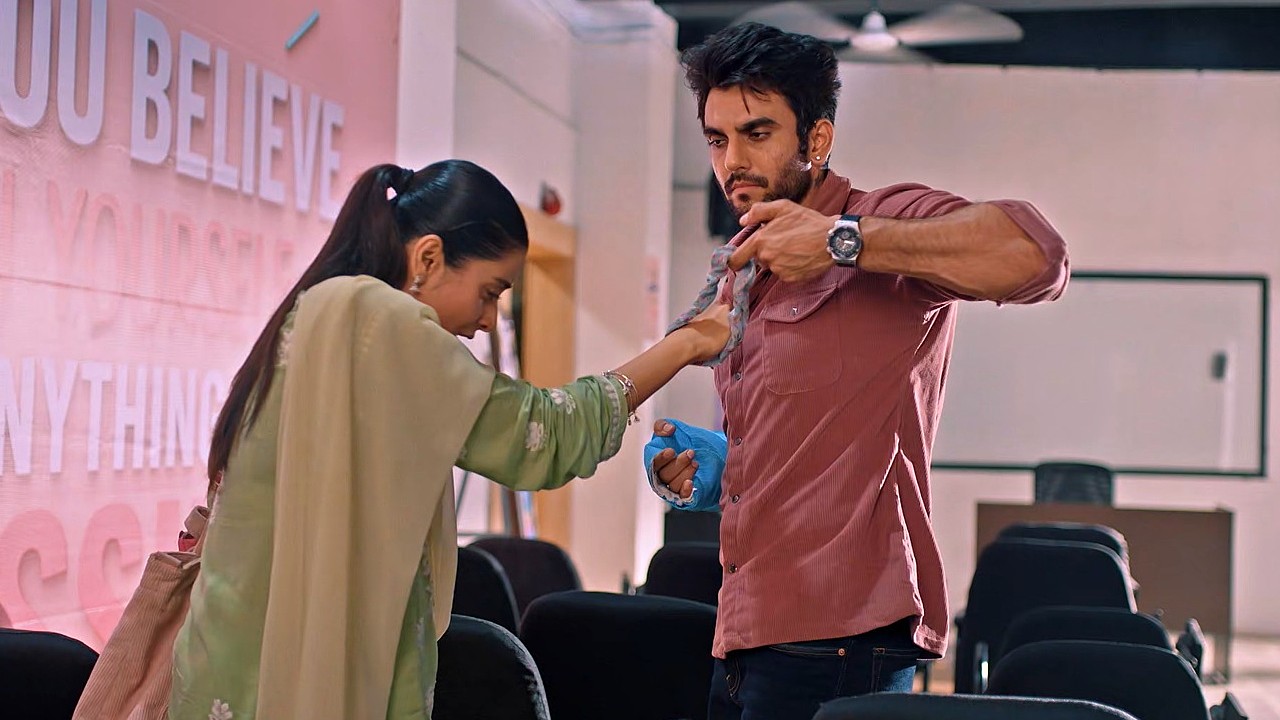
Ridhan tries to hand Jeet a leaked copy of the test, but Jeet literally sets it on fire to keep his hands clean. On the exam day, Jeet’s fractured arm gives out under the unbearable pain. Meanwhile, Shaurya ensures no student volunteers as a proxy writer for Jeet. Enter Saumya, who channels her inner Bhagavad Gita wisdom, marches straight past Shaurya, grabs the pen, and becomes his proxy writer.
Saumya’s father, Anoop, walks in, catches her red-handed aiding the campus “troublemaker,” and suffers a full-blown pride meltdown. He grounds Saumya from college until Jeet is gone for good. As Dadi reveals to Nita that Jeet previously saved Ridhan from Shaurya, an emotionally conflicted Saumya remains trapped in painful silence when her dad demands to know why she keeps defying the family.
Character Development
Soumya’s week was nothing short of a rollercoaster. She began as a shadow of herself, weighed down by guilt, trauma, and the suffocating grip of family expectations. So silent, she practically disappeared, even as Jeet took the fall for protecting her. But then Jeet’s no-nonsense pep talk, served with sugar parathas, planted the first spark of rebellion.
That spark quickly turned into fire. Fueled by a potent mix of basic moral duty and some serious Geeta energy, Soumya traded her passive door-mat era for full-on active defiance. Before you know it, she is dropping pens in the principal’s face to refuse a false statement, blackmailing Jeet to orchestrate Ridhan’s rescue, and casually throwing her family reputation under the bus just to step in as Jeet’s proxy writer. By the week’s end, she owned her choices, consequences be damned.
Psychologically, it’s a textbook shift from freeze-and-please to fight-and-choose. Trauma victims often default to “fanning” or “freezing”—staying silent, pleasing authority figures (her parents, her uncle), and making themselves small to avoid conflict or danger. Initially, Soumya let Jeet take the blame because her brain evaluated self-preservation and family peace as the safest options. But watching Jeet repeatedly suffer for her protection cracked that logic wide open. The guilt of staying quiet became heavier than the fear of conflict.
Jeet’s blunt advice worked like a cognitive reset, but it was Soumya’s recall of the Bhagwat Geeta that gave her the framework to act. She stopped asking what punishment her family might unleash and started asking what truth demanded of her. Writing Jeet’s exam wasn’t just about helping him. Taking the pen from his hand was more than an act of support. It was her way of reclaiming agency stolen by years of silence.
On the other hand, Jeet’s baseline used to be physical, short-tempered action. This week, his character showed extraordinary emotional regulation. He endured physical beatings during the football match to honor a promise, absorbed a slap from Anoop out of respect for a protective father, and burned a leaked exam paper to maintain absolute integrity. Instead of losing his temper over his father’s unfair traps, he used irony (like sending sweets to the Saxena Mansion) to maintain emotional control over a hostile situation.
By the end of the week, Jeet stopped looking like a hot-headed loner and solidified his place as a protector who turned his own past isolation into a shield for others.
Jeet fits the “Wounded Healer” mold almost too perfectly. His urge to protect isn’t some random heroic streak. Instead, it’s stitched together from years of abandonment and injustice. He spots Saumya’s silent terror because he’s lived that silence himself. The rage he carries could have burned the world down, but instead he sharpens it into a shield. Saving her gives his pain a purpose, and turns his fury into something almost noble.
Integrity and strength are the pillars of Jeet’s identity, so when power-hungry figures like Tripathi or Sanjeev prey on the weak, it’s personal for him. Every time he steps in, he is not only defending someone else, he’s reaffirming who he is. Still, he’s too guarded to ask for connection outright. Playing protector becomes his way to bond with Saumya without peeling back his own defenses.
Watching her freeze under trauma hits him like déjà vu. He knows that paralysis too well, and his instinct is to hand her the agency he once craved. By taking the blows (whether it’s humiliation, expulsion threats, or fists), he builds a bubble where she can breathe, speak, and fight back without being crushed.
Protecting Saumya isn’t just about her survival. It’s Jeet’s way of rewriting his own script. If she walks away unbroken, then somewhere deep down, he proves to himself that he wasn’t broken either.
At this point, Jeet and Saumya’s bond can simply be seen as two trauma‑scarred allies standing side by side, slowly tipping into real devotion.
Ridhan’s (Arnav Maggo) arc this week was quietly heroic. He shifted from passive spectator to moral compass. He flatly rejected his parents’ shady schemes and planted himself firmly on the side of justice. As Jeet’s step-brother and Saumya’s safe ally, he acted as the emotional anchor holding the triad together.
Ridhan’s kindness and protection towards Jeet stem from a powerful mix of unconscious fraternal duty, moral rejection of his parents, and deep psychological guilt. To him, Jeet embodies everything brave and honest that his own household fails to be. By standing guard over him, Ridhan is protecting the last piece of his own humanity.
Anoop’s story is about love colliding with pride. On one hand, he shielded Soumya fiercely, and refused to believe the gossip or the fake AI photos, standing tall against toxic relatives. On the other, his protectiveness hardened into control when she broke his expectations. Her public defiance to help Jeet felt less like courage to him and more like betrayal.
Unlike a static antagonist or a simple supportive father, Anoop is torn between two forces inside him. His unconditional love for Soumya keeps clashing with his obsession over family honor and what society thinks. The tragedy is that he confuses protection with control. He truly loves his daughter, but his self-worth is tied to appearances. When Soumya claims her own agency, it shatters his illusion of control, forcing him to choose between rigid pride and truly seeing her strength.
This week, Saumya’s mother came across as the architect of her daughter’s silence. Whenever Saumya mustered the courage to confront the horror of her past (hinting at past abuse linked to Roop), her mother stepped in to smother her voice. Watching Roop give music lessons to Pihu triggered Saumya’s deepest distress, yet she brutally invalidated that pain.
Saumya’s mother’s obsession with social status is ruthless. By framing Saumya’s truth as a threat to household respectability, she conditions her daughter to feel guilty for her own suffering, while the abuser stays protected under a blanket of decorum. Psychologically, acknowledging the wrongdoer’s actions would shatter the fragile family image she clings to, so she chooses comfort over her child.
While Anoop lashes out with loud threats, the mother’s cruelty is quieter but more insidious. She dismantles Saumya’s voice from within. That makes her the ultimate gatekeeper of silence. She is the one who ensures the past stays buried and keeps Saumya trapped in a prison built of guilt and shame.
In short, Saumya’s mother acts as a classic enabler-protector hybrid. She isn’t necessarily evil for the sake of malice, but her terrifying cowardice makes her prefer her daughter’s ongoing destruction over the collapse of her own comfortable lie.
We are in Week 2, and Roop’s (Aman Verma) presence is chilling precisely because it’s never spelt out. It creeps in through hints, silences, and the way the family bends around him. The biggest trigger comes when he starts teaching music to Pihu. For Saumya, the music lessons carry the memory of buried trauma.
Whenever she tries to resist or even shows distress, the family’s reaction is wildly out of proportion. Instead of asking why their daughter is terrified, her mother forces her to apologize, a move that screams of an unspoken pact: Roop’s status must remain untouchable. The mother’s frantic gaslighting only sharpens the suspicion. If Saumya’s fear were baseless, there would be no need for such aggressive silencing.
Saumya herself carries the classic guilt of victims abused by trusted relatives. She feels wrong for even remembering, convinced that speaking up would destroy the family. That guilt is the cruelest conditioning of all. By keeping Roop’s actions implied rather than explicit so far, the narrative mirrors the reality of familial abuse.
Meanwhile, instead of growth, the antagonists sank deeper into spiteful schemes. Shaurya slided from brute-force intimidation into something nastier, weaponizing AI to smear reputations. Meanwhile, Sanjeev and Nita tossed their roles as educators out the window, twisting rules and setting traps to feed their personal vendetta against Jeet.
Highlight Of The Week
In Yeh Fitoor Hai, the visuals are psychological roadmaps. Last week, the birdcage on Jeet’s terrace captured Saumya’s external confinement, showing how his chaotic presence rattled her quiet submission. This week, the metaphor shifts inward with the billiard balls. Jeet used the tightly racked formation to show Saumya that her real prison isn’t outside; it’s the invisible cage she’s built inside herself. A ball trapped in the center can only break free if it pushes out on its own. He gave her the harsh truth that she can’t spend her life hiding behind fear.
His challenge cracked her old defense of passive endurance. Instead of shrinking, Saumya started pushing back—against her family, against her own fear, even if she stumbled along the way. The billiard balls became a symbol of her agency, marking the moment she began to fight for her voice rather than bury it.
Further, in the show, there are times when the objects speak louder than words. Jeet’s habit of talking to the earthen pot holding his Naani’s ashes is his moral sounding board. In a world of lies and manipulation, that pot represents the only pure, uncorrupted bond he has left. Confiding in it about Saumya reveals his vulnerability.
The pull-up scene with his fractured arm is equally haunting. Jeet turns his own body into a ledger of guilt, punishing himself to justify taking Anup’s slap.
For Saumya, the hair scrunchie around her wrist is her lifeline. Twisting it grounds her when panic surges. It’s her private anchor against trauma. But when Shaurya’s AI smear campaign drives her into despair, Jeet slips his fingers into that scrunchie to pull her out of her spiral. In that moment, the item transforms from a solitary coping tool into a shared symbol of safety and trust.
That safe connection fractures the second Jeet claims her as his “girlfriend” to the public. Saumya’s sharp gesture of snatching the scrunchie back is a declaration of agency. She accepts his comfort but refuses to let anyone define her identity. Reclaiming the scrunchie is her way of setting a firm boundary.
Performances
This week’s Yeh Fitoor Hai episodes hit a new emotional peak, with Debchandrima delivering some gut‑wrenching acting. In the classroom breakdown scene after Shaurya’s AI smear, her hyperventilating panic felt raw and terrifyingly real.
The detailing was just as powerful when she rebukes Jeet for calling her his girlfriend as she lays bare the weight of slut‑shaming and family honor. Moments later, she walks away with slumped shoulders, carrying an invisible burden that says more than words ever could. That single shift in body language transformed the scene from a heated argument into a heartbreaking portrait of Saumya’s ongoing fight for autonomy.
If Debchandrima filled the classroom scene with trembling breaths, shivers, and tears to make Saumya’s panic feel painfully real, Ishhan Dhawan chose the opposite weapon—stillness. When Jeet slipped his fingers into the hair scrunchie on Saumya’s wrist, he wasn’t just pulling her out. He was also signaling respect for her boundaries. Ishhan’s portrayal here is what made it land. He didn’t play it as a grand rescue. Instead, he leaned into restraint. His stillness, his softened voice (when he says Saumya, utho), and the way he let the silence breathe turned the scrunchie into a bridge of trust. Ishhan’s choice to underplay the moment gave it emotional weight.
At the same time, he also shone in physicalizing his character’s internal chaos during the fractured‑arm pull‑up scene. Every grunt and strain on his face carried the weight of Jeet’s unexpressed guilt over Anoop’s slap.
Further, what makes the late-night scenes between Debchandrima and Ishhan Dhawan so magnetic is how effortlessly they translate their character’s emotional weight into a silent, unspoken language. In these late-night encounters, the story is told through the space between their characters. Dhawan uses a soft, protective gaze that anchors the frame, while Debchandrima matches him with tiny shifts in her body language.
In A Nutshell
The second week of Yeh Fitoor Tera showed how the drama is breaking free from the usual daily‑soap formula, leaning on objects and visuals to tell a deeper, psychological story. What makes this phase stand out is its quiet power. Roop’s menace lurks in silence, Saumya’s mother polishes her gaslighting under the shiny badge of “family honor,” and the late‑night exchanges between the leads speak louder than any dialogue.
Debchandrima’s razor‑sharp detailing and Ishhan Dhawan’s art of stillness gave the narrative its bite. If this week was about Saumya breaking the rack, the next promises the scatter that follows.


